
Azure Integration Services
Integration Microservice: Secure AS2 Integration with Azure
Modern businesses rely on seamless data exchange with customers, suppliers, distributors, and trading partners. When exchanging critical business documents such as purchase orders, invoices, shipping notices, and payment information, organizations need an integration solution that is secure, reliable, scalable, and easy to manage. An Integration Microservice built around Azure can help businesses achieve exactly that.
With an AS2 Azure Microservice, organizations can securely exchange EDI and other structured business documents over the internet while taking advantage of Microsoft’s cloud infrastructure. By combining AS2 capabilities with Azure services, businesses can simplify partner integration, improve operational visibility, and create a more flexible integration environment.
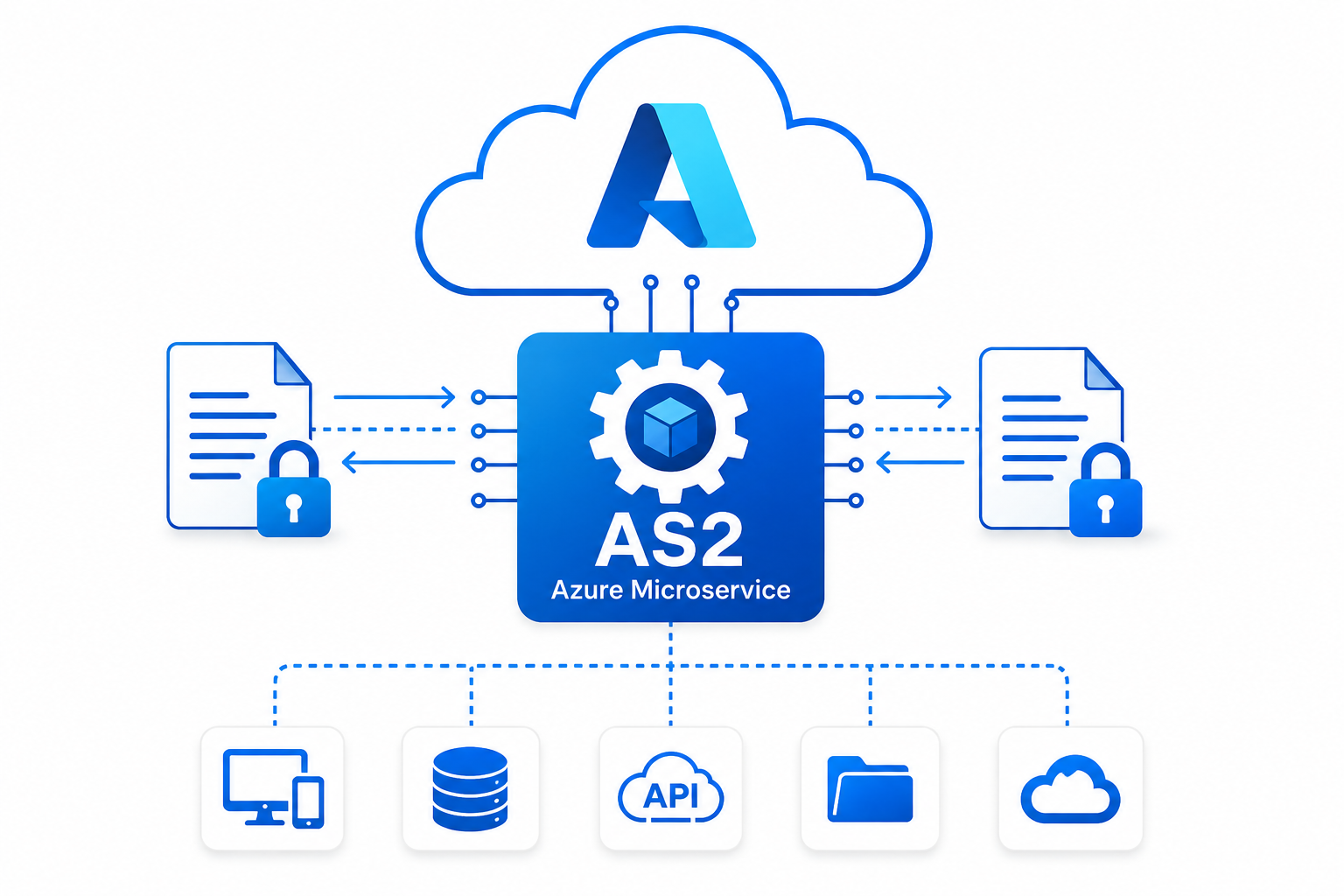
What Is an AS2 Azure Microservice?
An AS2 Azure Microservice is a cloud-based integration component designed to send and receive business documents using the Applicability Statement 2 (AS2) protocol. AS2 is widely used for secure B2B communication because it supports encryption, digital signatures, authentication, and message delivery confirmation.
A microservice-based approach separates AS2 functionality into a focused, independently manageable service. Instead of building a large, tightly connected integration platform, businesses can use a dedicated microservice to handle AS2 communication while other applications manage business logic, transformations, workflows, and data processing.
When deployed on Azure, the microservice can connect with enterprise applications, databases, APIs, storage platforms, and other cloud services. This makes it suitable for organizations that need to modernize traditional EDI and B2B integrations without completely replacing their existing systems.

Why Choose Azure AS2 Integration?
Azure AS2 Integration combines secure B2B document exchange with the scalability and flexibility of Microsoft Azure. Businesses can use Azure’s cloud environment to build integration workflows that connect trading partners with internal applications.
One of the key benefits is scalability. As transaction volumes increase or new trading partners are added, an Azure-based architecture can support changing workloads without requiring organizations to maintain extensive on-premises infrastructure.
Security is another important advantage. AS2 supports encryption and digital signatures, helping protect business documents while they are exchanged between organizations. Azure’s broader security capabilities can complement these protocol-level protections and support enterprise security requirements.
Azure-based integration can also improve monitoring and operational visibility. Teams can track message processing, identify failed transactions, investigate errors, and maintain greater control over B2B communication processes.
AS2 for Azure Logic Apps
For organizations already using Microsoft Azure, AS2 for Azure Logic Apps can provide a practical way to incorporate AS2 communication into automated workflows. Azure Logic Apps helps businesses connect applications, services, and data sources through workflow-based integration.
An AS2 workflow can receive a document from a trading partner, validate and process the message, transform the data into the required format, and send it to an internal business application. The reverse process can generate and securely transmit outbound documents to external partners.
This approach can reduce manual intervention and help businesses automate repetitive B2B processes. It can also make integrations easier to maintain because individual workflow components can be updated as business requirements change.
Key Features of an AS2 Integration Microservice
A well-designed integration microservice can support several important capabilities:
Secure document exchange
AS2 supports encrypted and digitally signed messages, helping organizations protect sensitive business information.
Message processing
Incoming and outgoing documents can be processed according to business and partner-specific requirements.
MDN support
Message Disposition Notifications can confirm that an AS2 message was received and processed according to communication requirements.
Partner management
Businesses can manage different trading partners, certificates, endpoints, and communication configurations within their integration architecture.
Data transformation
Documents can be transformed between EDI, XML, JSON, or other required formats before reaching downstream applications.
Monitoring and logging
Integration teams can monitor transaction status, identify failures, and troubleshoot communication issues more efficiently.
Scalable architecture
A microservice can be independently scaled and maintained as transaction volumes and integration requirements evolve.
Benefits for Modern Businesses
Moving AS2 communication to an Azure-based microservice architecture can offer several business benefits. Organizations can reduce dependency on legacy infrastructure while creating a more adaptable integration environment.
It can also accelerate partner onboarding. Once the core integration architecture is established, organizations can incorporate new trading partners using their specific AS2 endpoints, certificates, and document requirements.
Another benefit is improved reliability. Cloud-based integration gives businesses a centralized environment to monitor transactions and manage integration workflows. Automated processing also reduces the risk of errors associated with manually handling business documents.
For organizations pursuing digital transformation, an Azure-based AS2 architecture bridges traditional EDI communication and modern cloud applications.
Build a Future-Ready B2B Integration Strategy
Businesses today need more than basic file exchange. They need integration systems that can connect partners, applications, and data while maintaining security, reliability, and scalability.
An AS2 Azure Microservice provides a focused approach to secure B2B communication, while Azure AS2 Integration can connect AS2 transactions with broader cloud-based business processes. With AS2 for Azure Logic Apps, organizations can further automate workflows and connect trading-partner communication with applications across their technology environment.
By combining AS2 security with Azure’s flexible integration capabilities, businesses can build a reliable architecture that is ready to support today’s transactions and tomorrow’s growth.