
On-Prem AS2 Microservice
Integration Microservice for Secure Enterprise AS2 Communication
In today’s connected business environment, organizations need reliable and secure ways to exchange critical business documents with customers, suppliers, logistics providers, financial institutions, and trading partners. AS2 Communication provides a proven method for exchanging electronic data securely over the internet while supporting authentication, encryption, and message integrity.
An Integration Microservice can simplify this process by providing a flexible integration layer between enterprise applications and AS2-based trading partners. Whether your organization requires an On-Premise AS2 deployment or a scalable Enterprise AS2 Solution, an integration microservice can help streamline document exchange while maintaining control, security, and operational efficiency.
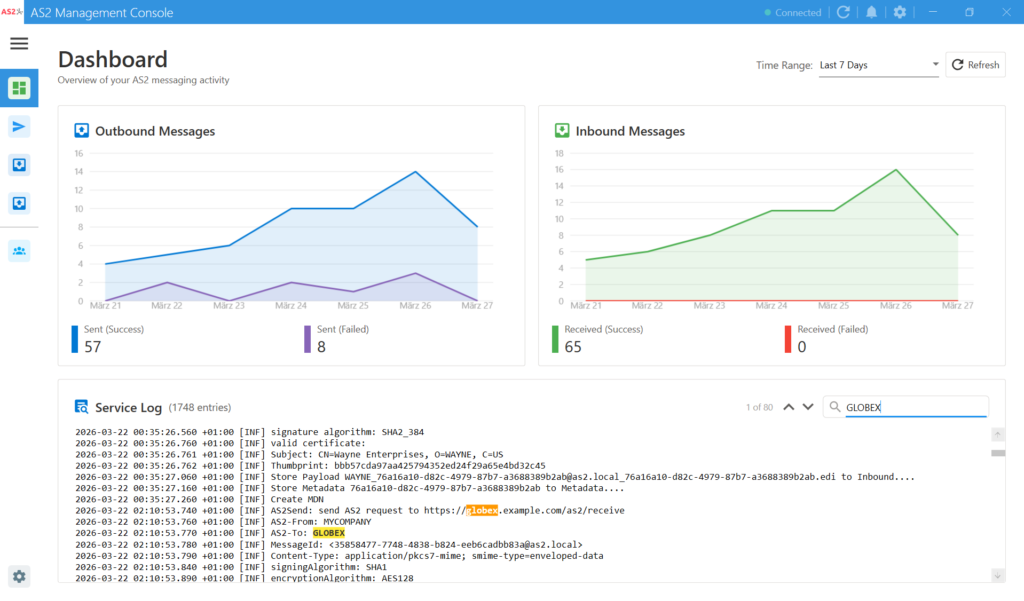
AS2 Messaging Dashboad
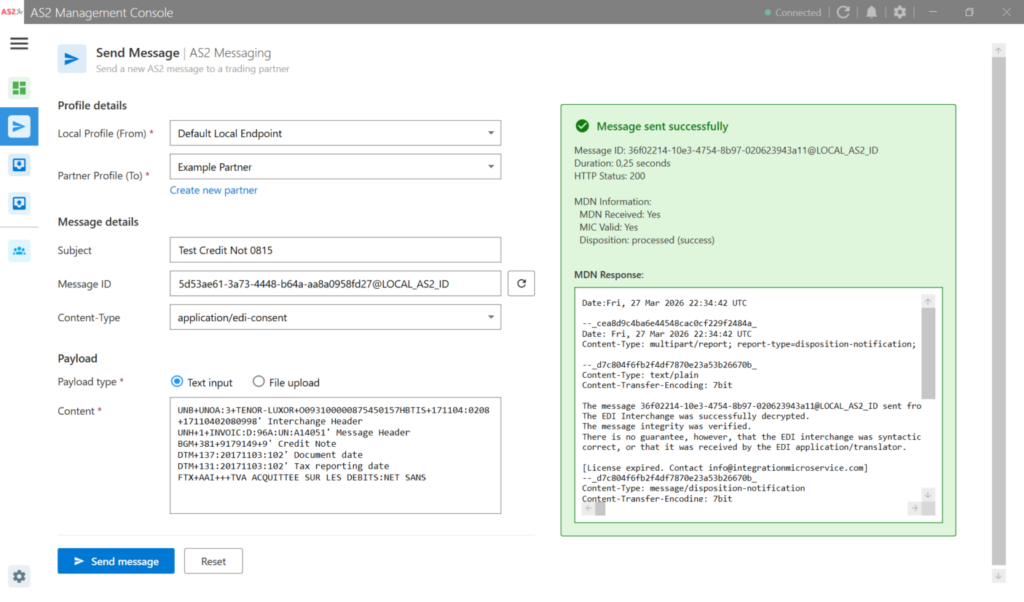
Send AS2 Message with Desktop Client
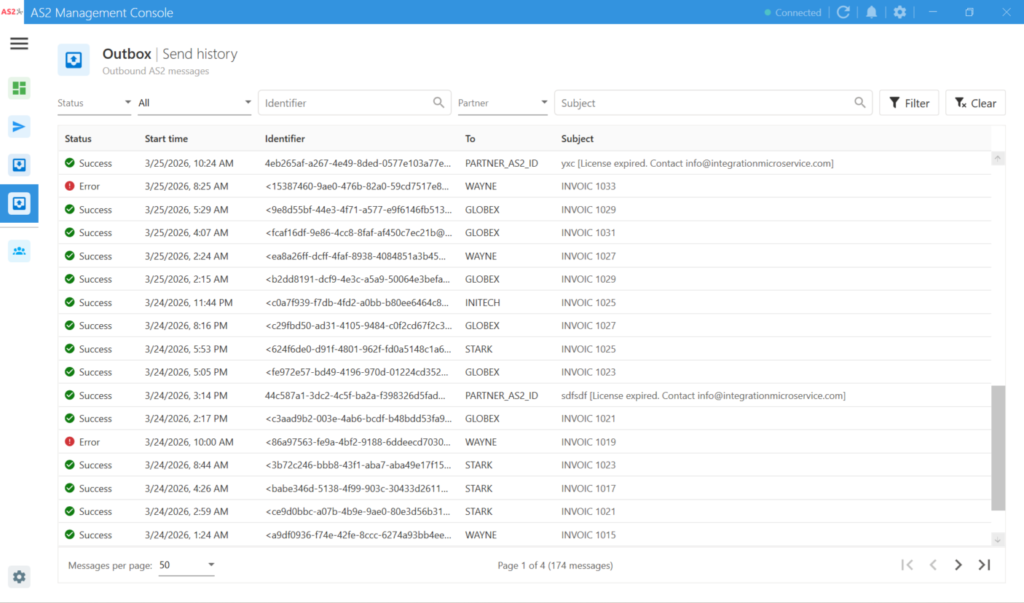
AS2 Message History
What Is an AS2 Integration Microservice?
An AS2 integration microservice is a specialized software component that manages the exchange of business documents using the Applicability Statement 2 (AS2) protocol. It can connect internal enterprise applications, such as ERP, CRM, supply chain, or document management systems, with external trading partners.
Instead of creating complex point-to-point integrations for every partner, organizations can use a centralized microservice to manage AS2 messages, security requirements, acknowledgments, routing, and integration workflows.
This architecture makes it easier to support growing partner networks while maintaining a consistent approach to Secure AS2 Communication.
Why Choose an On-Premise AS2 Solution?
An AS2 On-Premise Solution is ideal for organizations that require greater control over their infrastructure, data, security policies, and integration environment. With an on-premise deployment, AS2 services can operate within the organization’s own data center or controlled infrastructure.
An On-Premise AS2 implementation can be particularly valuable for businesses operating in industries where data governance, regulatory requirements, or internal security policies require tighter control over sensitive information.
Key advantages include:
- Greater control over infrastructure and configuration
- Integration with existing enterprise security systems
- Support for internal compliance and governance requirements
- Direct management of certificates and encryption keys
- Reduced dependency on external hosting environments
- Flexible integration with legacy and modern enterprise applications
By deploying AS2 capabilities within an existing environment, businesses can build a dependable document exchange infrastructure tailored to their operational requirements.
Secure AS2 Communication for Business-Critical Data
Security is one of the primary reasons organizations use AS2. Secure AS2 Communication enables businesses to protect documents while they are transmitted between trading partners.
AS2 supports security mechanisms such as encryption, digital signatures, and message integrity verification. It can also use Message Disposition Notifications (MDNs) to provide confirmation that a message has been received and processed according to the agreed communication workflow.
An integration microservice can centralize these capabilities, helping organizations manage security policies consistently across multiple trading partners.
From supplier purchase orders to invoices, shipping documents, and other EDI transactions, secure communication is essential to protect business information and maintain partner trust.
Simplifying AS2 Communication
Managing individual AS2 connections manually can become challenging as the number of trading partners increases. Each partner may have different requirements for endpoints, certificates, encryption, signing, document formats, and acknowledgments.
An integration microservice can simplify AS2 Communication by providing a standardized integration layer. It can receive documents from internal applications, transform or route them when necessary, and deliver them securely to the appropriate trading partner.
The same architecture can manage incoming AS2 messages and make them available to internal systems through APIs, queues, file interfaces, or other integration mechanisms.
This approach can help organizations reduce integration complexity while improving visibility into business document exchanges.
An Enterprise AS2 Solution Built for Scalability
Large organizations often need to communicate with hundreds or thousands of business partners. An Enterprise AS2 Solution should therefore be designed for scalability, reliability, monitoring, and centralized administration.
A microservice-based architecture can support these requirements by separating integration functions into manageable services. Organizations can scale specific components based on transaction volumes without redesigning the entire integration environment.
An enterprise-ready implementation can support:
- Multiple trading partner connections
- High-volume document exchange
- Delivery and acknowledgment tracking
- Integration with ERP, CRM, EDI, and other enterprise systems
- Automated message routing
- Certificate and security management
- Centralized monitoring and operational visibility
- Error handling and retry mechanisms
This makes the solution suitable for organizations that need dependable B2B communication across complex business ecosystems.
Build a Future-Ready AS2 Infrastructure
As organizations modernize their integration environments, they need solutions that can work alongside existing systems while supporting future technologies. A microservice-based approach provides the flexibility to evolve an AS2 infrastructure without replacing the entire enterprise integration landscape.
Whether you are implementing an On-Premise AS2 platform, upgrading an existing AS2 On-Premise Solution, or building a scalable Enterprise AS2 Solution, an integration microservice can provide the foundation needed for secure, reliable, and efficient B2B document exchange.
With centralized management, secure transmission, scalable architecture, and integration with enterprise applications, organizations can simplify AS2 Communication while strengthening Secure AS2 Communication across their trading partner network.
Strengthen Your B2B Integration Strategy
AS2 remains an important technology for organizations that depend on secure and reliable electronic document exchange. By combining AS2 capabilities with a modern integration microservice architecture, businesses can create a flexible platform that supports current partner requirements and future growth.
From controlled On-Premise AS2 deployments to comprehensive Enterprise AS2 Solutions, the right integration architecture can help improve security, reliability, scalability, and operational efficiency while making complex B2B communication easier to manage.
Free Trial
Try Before You Buy
- Free trial – Full feature access
- No credit card required – Just download and install
- Full technical support – We'll help you succeed
- Easy activation – Upgrade to licensed version anytime
Monthly Subscription
250 € per month
- No upfront costs
- Cancel anytime
Annual License
2800 € per year
- 12 months of coverage
- Save 200 € per year
Data Sovereignty
- Your Infrastructure – No unencrypted data leaves your network
- Compliance Ready – Meet data residency requirements
- Audit Trail – Complete message history on your storage
- No Cloud Dependency – Operate without cloud provider
Security & Control
- Zero Trust Architecture – No third-party access to your data
- Custom Firewall Rules – Full control over network security
- Certificate Management – Use your own PKI infrastructure
Cost Predictability
- Fixed Pricing – No surprise per-message fees
- Unlimited Volume – Scale without cost increases
- No Bandwidth Charges – Use as much as you need
- One-Time Setup – No recurring platform fees